
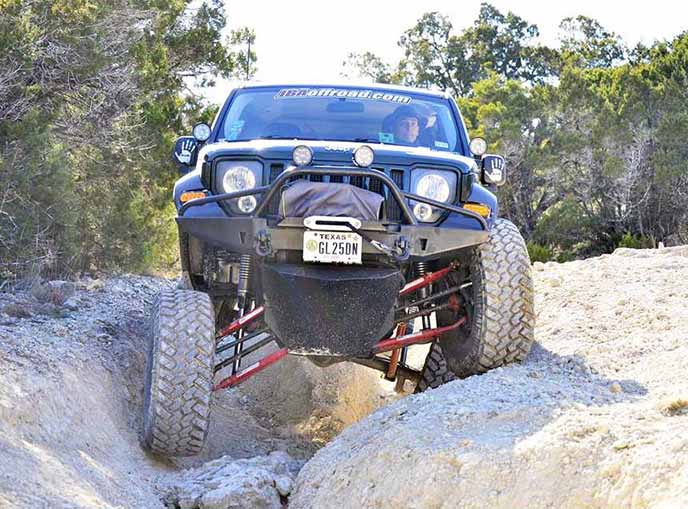
If you've been researching lift kits or suspension upgrades, you've probably run into the term "ball joint UCA," sometimes compared to "uniball UCAs," and wondered what the difference actually is and which one you need. It's one of those topics where the off-road community assumes you already know the basics, and nobody stops to explain from the beginning. So let's fix that.
Start With the Basics: What Is a UCA?
An upper control arm (UCA) is a suspension component that connects your truck's frame to the steering knuckle, the part your wheel hub and brake assembly bolt to. It works in tandem with the lower control arm to control how your wheel moves up and down as the suspension compresses and extends.
The UCA doesn't just hold the wheel in place. It governs suspension geometry, specifically caster and camber angles, which affect how your truck steers, how your tires wear, and how stable the vehicle feels at speed.
Stock UCAs are engineered for one specific ride height: factory height. The moment you lift your truck, that geometry changes, and your stock arms start working against you rather than with you.
So What's a Ball Joint UCA?
A ball joint UCA is simply an upper control arm that uses a ball joint as its pivot point where the arm connects to the steering knuckle. The ball joint is a spherical bearing, a ball inside a socket, that allows the arm to pivot in multiple directions as the suspension moves.
Most factory UCAs already use a ball joint design. When people refer to an "aftermarket ball joint UCA," they're talking about a replacement or upgraded arm that still uses a ball joint but with:
-
Improved range of motion compared to the stock ball joint
-
Stronger construction (tubular or forged steel vs. stamped)
-
Adjustability for correcting caster angle after a lift
The ball joint is pressed or bolted into the arm, and in many designs it's replaceable, meaning when the ball joint wears out, you swap it rather than replacing the whole arm.
Ball Joint UCA vs. Uniball UCA: What's the Difference?
This is where a lot of people get confused. Both terms describe the pivot point in a UCA, but they're different designs:
|
Feature |
Ball Joint UCA |
Uniball UCA |
|
Joint type |
Traditional ball-and-socket with rubber or polyurethane boot |
Open bearing (no boot), metal-on-metal contact |
|
Range of motion |
Good, significantly better than stock in aftermarket versions |
Excellent, greatest articulation available |
|
Maintenance |
Low, sealed or greaseable, longer service intervals |
Higher, requires periodic inspection and re-greasing |
|
Street use |
Very comfortable, quieter, better for daily driving |
Can transmit more road noise/vibration |
|
Off-road use |
Strong performer for most trail and overlanding use |
Preferred for extreme rock crawling or competition |
|
Cost |
Generally lower |
Generally higher |
The short version: Ball joint UCAs are the better all-around choice for trucks that see a mix of street and trail use. Uniball UCAs are the choice for dedicated off-road builds where maximum articulation is the priority, and some extra maintenance is acceptable.
Why Aftermarket Ball Joint UCAs Beat Stock
Even if your truck came with a ball joint UCA from the factory, there are strong reasons to upgrade once you lift it:
1. More Articulation
Stock ball joints have a limited range of motion, typically 20–25 degrees of articulation. Push them past that range (which happens quickly after a lift), and you get binding, uneven suspension movement, and accelerated wear. Aftermarket ball joint UCAs are designed with wider articulation ranges that accommodate lifted geometry.
2. Caster Correction
Lift your truck without correcting caster angle, and you'll wear through a set of tires faster than you'd believe. Aftermarket ball joint UCAs frequently include adjustable mounting points to bring caster back into spec, something a stock arm simply can't do.
3. Stronger Materials
Stock stamped-steel arms weren't built for the leverage and impact stress that come with bigger tires and off-road terrain. Aftermarket ball joint UCAs in tubular or forged steel handle that stress far better.
4. Replaceable Ball Joints
Many aftermarket designs use serviceable ball joints that can be replaced individually when they wear out, a much cheaper long-term proposition than replacing the entire arm.
Do You Need a Ball Joint UCA for Your Build?
Here's a practical guideline based on lift height:
-
Stock height or leveling kit only: OEM arms are fine; check ball joint condition periodically
-
2–3.5" lift: Aftermarket ball joint UCAs are recommended to correct geometry and avoid binding
-
4"+ lift: Aftermarket UCAs are essentially required; evaluate ball joint vs. uniball based on how much off-road vs. street use your truck sees
-
Dedicated off-road / rock crawling build: Uniball UCAs are worth the extra cost and maintenance
The Bottom Line
A ball joint UCA isn't a complicated concept; it's an upper control arm with a ball-and-socket pivot that connects your suspension to your steering knuckle. What makes aftermarket versions worth it for lifted trucks is the combination of greater articulation range, adjustable geometry, and stronger materials that stock arms can't offer.
If you've lifted your truck and haven't addressed your UCAs yet, it's worth a look; your tires and alignment will thank you.
Browse JBA Offroad's ball joint UCA lineup, matched to your specific truck and lift height.
[Shop ball joint UCAs] | [Find your fitment] | [Talk to our team]
Have questions about whether a ball joint or uniball UCA is right for your build? Reach out; we're happy to help you think it through.