
Quick answer
A bad ball joint or worn bushing in your upper control arm shows up as clunking over bumps, uneven tire wear, steering wander at highway speed, vibration under braking, visible play when you jack the wheel, a pull to one side while braking, or a loose, disconnected feel over rough ground. These all come from the same root cause: the arm has lost its ability to hold wheel alignment (camber and caster) as the suspension moves.
This guide walks through all seven signs, how to tell an upper control arm problem from a lower control arm problem, and what to look for in a replacement.
How does an upper control arm work?
The upper control arm connects your vehicle's frame to the steering knuckle, controlling vertical wheel movement while maintaining alignment angles. It pivots on bushings at the frame mount and terminates in a ball joint at the knuckle, allowing the suspension to compress and extend without altering camber or caster settings.
When bushings wear or ball joints loosen, the arm loses its ability to hold geometry. Your wheel tilts out of spec, steering inputs become vague, and suspension loads transfer unevenly. That's why a bad upper control arm affects both handling precision and tire longevity.
Off-road vehicles wear these components faster than street-only rigs — articulation cycles, impact loads, and exposure to mud and water all degrade sealed components at a faster rate than pavement driving alone. It's the reason we build our bushings to be serviceable in the first place: a sealed component that only has to survive pavement doesn't need a grease port, but one that has to survive a rutted trail does.
The 7 warning signs of a bad ball joint or worn bushing
1. Clunking or knocking noises over bumps
A worn ball joint or a loose bushing allows metal-to-metal contact during suspension cycles. You'll hear a distinct clunk from the front corner of the vehicle, especially over potholes, speed bumps, or washboard trails.
This symptom worsens with load. An empty vehicle may only knock occasionally, but adding gear or passengers increases suspension travel and makes the clunking constant. If you're hearing it at low speed in a parking lot, the wear is already significant.
2. Uneven or accelerated tire wear
A failing ball joint or bushing lets camber and caster drift beyond factory spec. You'll see the inside or outside edge of your tire wearing faster than the center tread, because the wheel is no longer sitting perpendicular to the road.
An alignment shop can correct the angles temporarily, but if the bushings are collapsed or the ball joint is loose, the settings will drift again within weeks. Replacing tires without fixing the root cause just means doing it twice.
3. Steering wander or instability at highway speed
Worn bushings create play in the suspension, which shows up as vague steering and constant small corrections to hold a lane on a flat, straight road. This gets worse above 55 mph and compounds in crosswinds or when a semi passes you — the play in the joint means the wheel isn't responding predictably to small steering inputs anymore.
4. Vibration through the steering wheel
A loose ball joint or worn bushing lets the wheel assembly oscillate under braking or acceleration loads, which you'll feel as vibration through the wheel — especially when you brake. Distinguish this from a warped rotor by checking whether the vibration happens on rough pavement without braking; if it does, the control arm or its joints are the more likely source.
5. Visible play in the ball joint or bushings

Jack the vehicle and grab the tire at 12 and 6 o'clock. Push and pull vertically — excessive movement points to a worn ball joint. Then grab at 3 and 9 o'clock and rock the wheel; if the control arm moves independently of the frame mount, the bushings have failed.
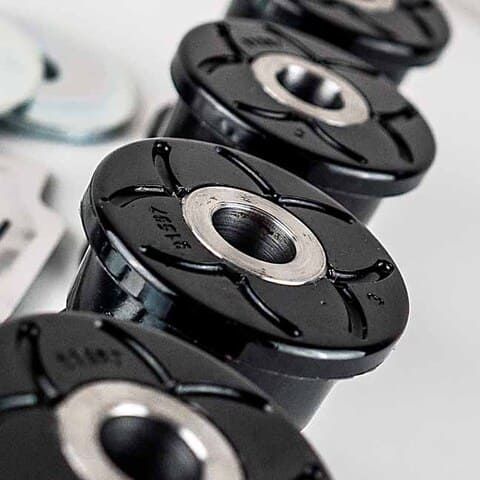
Check the rubber bushings visually, too. Cracks, tears, or missing material confirm wear. On a sealed bushing, that's the end of the road — you replace the whole arm. On JBA's EZ Lube Bushings, the 8 individual grease ports mean you can often catch and correct wear before it gets to that point.
6. Vehicle pulls to one side during braking
A bad ball joint or bushing on one side creates asymmetric suspension geometry, so the vehicle pulls toward the worn side under braking. This often shows up alongside uneven tire wear on the same corner. It's subtle during light braking but becomes pronounced — and dangerous — during a hard stop, since uneven braking forces increase stopping distance and reduce control.
7. Loose or rattling sensation in the front suspension
A worn control arm produces a loose, disconnected feel over uneven surfaces — the front end feels like it's floating or rattling instead of tracking smoothly, because the arm is no longer rigidly controlling wheel movement through its full range of travel. You'll notice this most on gravel, rutted trail, or rough pavement, and it often shows up alongside clunking and steering wander.
How do you tell an upper control arm problem from a lower control arm problem?
Both exhibit similar symptoms, but location and load give it away. Upper control arm failure tends to produce more steering wander and camber-related tire wear, since the upper arm controls the top of the wheel's arc. Lower control arm failure more often shows up as clunking during acceleration or braking, since it carries more of the vertical load.
Use the tire-rock test above to isolate it: vertical play at 12 and 6 o'clock points to the upper ball joint or bushings; horizontal play at 3 and 9 o'clock points to the lower control arm or tie rod. Listen for where the noise comes from, too — upper control arm clunks come from higher in the wheel well, near the frame rail. If you're not sure, have both arms inspected on a lift; a worn upper arm shows visible bushing deterioration or ball joint looseness once the suspension is unloaded.
What happens if a ball joint fails completely?
Complete failure is a real, sudden problem. If the ball joint separates or the arm breaks, the wheel loses its connection to the frame — the tire folds in or out, and you lose steering control on that corner. At speed, that's a crash, not a limp home. A separated joint doesn't give you warning; it fails once the internal wear passes tolerance.
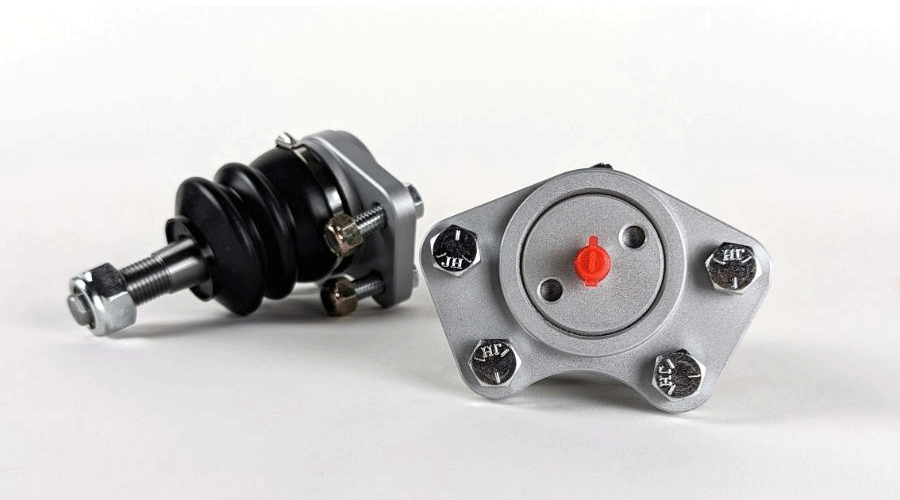
This is exactly the failure mode a rebuildable design is built to prevent. JBA's Max 90 Ball Joints are CNC-machined from 4140 chromoly steel with a fully rebuildable design — when the joint reaches its service interval, you replace the wear components, not the entire arm, which means you catch wear before it becomes a separation.
How long can you drive with a bad ball joint?
You shouldn't. The timeline from first symptom to failure depends on severity, driving conditions, and load, and it isn't predictable — a control arm producing occasional clunks might last weeks, but one with visible play could separate on the next hard impact. Off-road use accelerates all of it: articulation, shock loads, and contamination compound existing wear, so a joint that might survive 5,000 highway miles could fail in a fraction of that on the trail. If you're planning a remote trip, inspect and replace anything questionable before you leave pavement.
What to look for in a replacement upper control arm
Rebuildable ball joints vs. sealed joints. Sealed joints can't be serviced — when they wear out, you replace the whole arm. JBA's Max 90 Ball Joints are rebuildable: when the joint reaches its wear limit, you replace the stud and bearing components instead of the entire arm, which cuts long-term cost and means you don't need to carry a spare complete UCA on a trip.
Serviceable bushings with grease ports. Sealed bushings trap moisture and contaminants, which accelerates wear from the inside. JBA's EZ Lube Bushings (US Patent No. 11,293,511) use 8 individual grease ports with pressure relief valves, so you can flush contaminants and re-lubricate throughout the life of the arm instead of waiting for the rubber to fail.
Material and warranty. Upper control arms take bending loads during articulation and impact loads during compression — stamped steel can bend under hard use, cast aluminum can crack at stress points. Look for DOM tubing or forged construction with a real warranty behind it. Every JBA arm carries a lifetime structural warranty, backed by more than 50,000 sets sold since we started building them.
How do you prevent premature ball joint or bushing failure?
Grease rebuildable ball joints and serviceable bushings every 3,000 to 5,000 miles, or after every water crossing, using a MOLY EP lithium grease. Inspect for torn boots, loose hardware, or visible play during routine oil changes. Torque hardware to spec: the 4 bolts mounting the Max 90 ball joint to the A-arm to 13 ft-lbs, the ball joint stud nut to 60 ft-lbs, and the frame-mount bushing bolts to 80 ft-lbs — loose mounting hardware accelerates bushing wear faster than almost anything else.

Avoid overloading your vehicle beyond its suspension rating — extra weight from roof racks, bumpers, or armor increases control arm stress and accelerates joint wear; if you're running heavy accessories, look at control arms rated for the added load. And don't wait out a symptom once you've confirmed it — a clunking control arm is a warning, not a minor inconvenience, and a serviceable design like ours means fixing it early doesn't mean throwing away the whole arm.
Frequently asked questions
What happens when an upper control arm fails? The ball joint separates or the arm breaks, disconnecting the wheel from the frame. The tire collapses inward or outward and you lose steering control on that corner — at highway speed, that's an immediate crash.
How long can I drive with a bad control arm? You shouldn't. The timeline to failure is unpredictable and depends on severity of wear and driving conditions — visible play or persistent clunking means it could separate on the next hard impact.
What does a bad control arm feel like when driving? Steering wander that needs constant correction to hold a lane at highway speed, plus a loose or disconnected feel over bumps. Clunking and steering-wheel vibration are common alongside it.
Can a bad ball joint cause vibration when braking? Yes — a worn ball joint or bushing lets the wheel assembly oscillate under braking load, which you'll feel as vibration through the steering wheel that gets worse as you decelerate from higher speed.
Replace worn ball joints and bushings with rebuildable, serviceable parts
Catching a bad ball joint early prevents tire damage, alignment drift, and — worst case — a steering failure at speed. Clunking, uneven tire wear, and steering instability all point to worn bushings or a loose ball joint that needs attention now, not eventually.
At JBA Offroad, we build our upper control arms with rebuildable Max 90 Ball Joints and serviceable EZ Lube Bushings because sealed components fail without warning, and a fix that requires replacing the whole arm shouldn't be the only option. Every arm carries a lifetime structural warranty, backed by more than 50,000 sets sold. Shop upper control arms at JBA Offroad.