
What Are the Most Effective Chevy Colorado Suspension Upgrades?
The most effective Chevy Colorado suspension upgrades focus on upper control arms, dampers, and geometry-preserving lift kits. Factory Colorado suspension on WT and LT trims delivers 7.9 inches of ground clearance, while the Z71 reaches 8.9 inches and the Trail Boss hits 9.5 inches. The ZR2 tops out at 10.7 inches with Multimatic DSSV dampers and a factory 3-inch lift. Aftermarket upgrades that maintain towing capacity and wheel travel outperform simple spacer lifts.
This article is for Colorado owners who need more ground clearance, larger tire fitment, or improved off-road control without sacrificing daily drivability. You're researching which suspension components deliver measurable performance gains and which modifications create more problems than they solve.
We'll cover which suspension components matter most for your Chevy Colorado, how lift kits affect geometry and towing capacity, why upper control arms determine wheel travel and alignment, and which upgrades preserve factory ride quality while increasing capability.
Why Upper Control Arms Are the Foundation of Chevy Colorado Suspension Upgrades
Upper control arms control wheel travel, camber angles, and suspension geometry under compression. When you install lift kits or larger tires on your Chevrolet Colorado, stock control arms push the suspension geometry outside its designed range. Ball joints bind, camber goes negative, and you lose the wheel travel you paid to gain.
Aftermarket upper control arms with extended geometry restore proper alignment angles after a suspension lift. They relocate the ball joint positions to compensate for increased ride height, thereby preventing premature tire wear and maintaining steering response. The difference shows up immediately in how your truck handles washboard sections and articulates over obstacles.
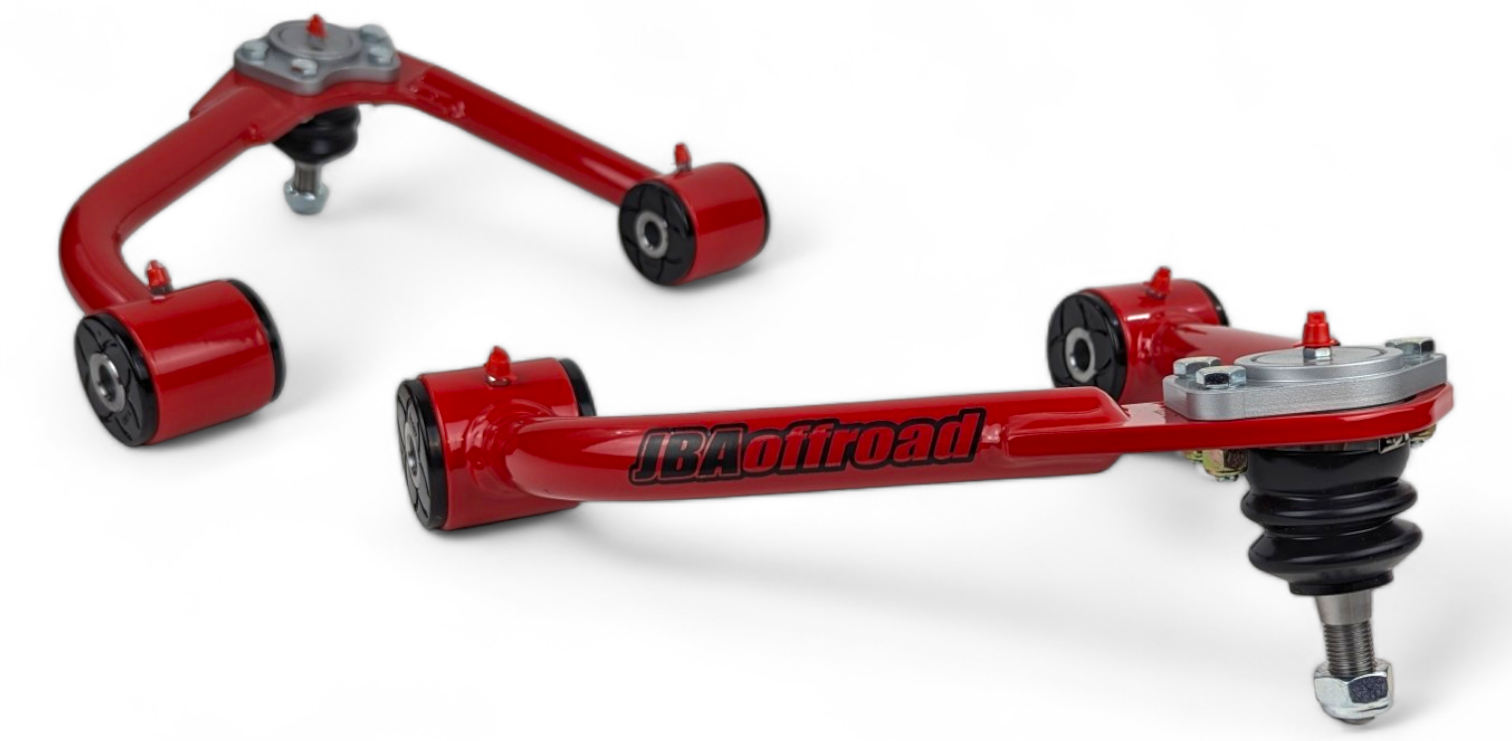
JBA Offroad engineers upper control arms with Max 90 Ball Joints CNC-machined from 4140 chromoly steel. These joints provide 90-degree articulation, allowing your suspension to compress and extend through its full range without binding. That articulation translates directly to wheel travel, the measurement that determines whether your tire stays planted on uneven terrain or hangs in the air.
The rebuildable design matters because ball joints wear. Sealed joints from other manufacturers require complete arm replacement when the joint fails. JBA's design lets you replace worn components without discarding the entire control arm, which reduces long-term ownership cost and keeps your Colorado on the trail instead of waiting for parts.
How Lift Kits Affect Suspension System Performance
Lift kits raise your Colorado's frame relative to the axles. A 2-inch lift on a Z71 increases ground clearance from 8.9 inches to roughly 10.9 inches, which allows 33-inch tires instead of the factory 32-inch all-terrain setup. That extra inch of clearance prevents tire contact with fender liners during compression and provides additional belly clearance over rocks and ruts.
The current aftermarket focuses on 1.75- to 3-inch lift kits because this range preserves towing capacity and CV axle angles. ICON's 2023-2026 Colorado lift claims a 20% increase in wheel travel over stock with no change in towing capacity. Zone Offroad markets a 3-inch lift kit for Trail Boss and GMC Canyon AT4 applications. These moderate lifts avoid the driveline vibration and steering geometry problems that plague larger lifts.
Block kits and spacer-style lifts raise the vehicle without addressing suspension geometry. They create the appearance of lift but push ball joints and tie rod angles outside their functional range. The result is accelerated wear, poor steering response, and reduced wheel travel. Engineered suspension systems that include new shocks, springs, and geometry-correcting control arms maintain vehicle dynamics while increasing ground clearance.
When evaluating lift kits, confirm the manufacturer specifies how the kit affects wheel travel, towing capacity, and alignment angles. Kits that only list ride-height increases without addressing geometry are red flags. Your Colorado's suspension components work as a system, and changing one dimension without compensating elsewhere degrades performance.
What Shocks and Dampers Do for Off-Road Control
Shocks control suspension velocity, not ride height. They determine how quickly your suspension compresses and rebounds, which directly affects how your truck handles washboard roads, rock crawls, and high-speed desert runs. The factory Multimatic DSSV dampers on the 2026 Colorado ZR2 use position-sensitive valving that adjusts damping force based on shaft position, providing firm control near full compression while remaining compliant in mid-travel.
Aftermarket shocks for WT, LT, and Z71 Colorados replace the factory monotube or twin-tube dampers with adjustable or application-tuned units. The goal is to match damping ability to your vehicle's weight, tire size, and intended use. A Colorado running 33-inch mud-terrain tires and a full skid plate package needs more damping force than a stock Z71 on 32-inch all-terrains.
Shocks and suspension lift kits should be matched. Installing a 3-inch lift with stock-length shocks limits droop travel and creates a harsh ride because the shock bottoms out before the spring reaches full extension. Quality lift kits include extended-length shocks valved for the new spring rates and ride height. If you're piecing together a suspension system, confirm that the shock's extended and compressed lengths match your new suspension geometry.
Gas-charged monotube shocks resist fade better than twin-tube designs during extended off-road use. The single-tube construction dissipates heat more efficiently, which maintains consistent damping when you're running trails for hours. Adjustable shocks let you tune compression and rebound damping for different loads and terrain, but they require understanding how damping changes affect vehicle behavior.
How Suspension Geometry Changes with Lift and Larger Wheels
Suspension geometry refers to the angles and positions of control arms, tie rods, and ball joints relative to the wheel hub. When you lift your Colorado, you change these relationships. A 3-inch body lift raises the frame but leaves the suspension in its stock position, altering steering geometry and creating bump steer. A suspension lift raises the entire suspension system, but without corrected control arms, you still end up with poor camber and reduced articulation.
The SST lift approach from ReadyLIFT and similar manufacturers uses strut spacers and rear blocks to achieve a 2.5-inch lift. This method is cost-effective but doesn't address upper control arm geometry, as detailed in our control arm comparison. Your ball joints operate at steeper angles, which reduces their functional range of motion and accelerates wear. For Colorado, which sees occasional gravel roads, this trade-off might be acceptable. For regular off-road use, it's a maintenance liability.
Complete upgrade kits designed for specific Colorado trims include geometry-correcting components. They pair lift springs with extended shocks, relocated control arms, and adjusted tie rod ends to maintain factory-like steering feel and wheel travel. The 2026 Colorado's independent front suspension benefits more from these complete systems than older solid-axle trucks do because IFS geometry is more sensitive to ride-height changes.
When you increase wheel travel through suspension upgrades, you also need to confirm your tires won't contact the frame or body at full compression. The Trail Boss comes with 32-inch tires on 18-inch wheels, and a 3-inch lift typically allows 33-inch tires without trimming. The ZR2 runs 33-inch mud-terrain tires on 17-inch wheels from the factory. Going to 35-inch tires usually requires fender modifications and may need wheel spacers to prevent rubbing at full lock.
Why Serviceability Matters in Suspension Components
Suspension components wear. Ball joints see constant articulation, bushings compress and rebound thousands of times per mile, and grease breaks down under heat and contamination. Sealed suspension components hide this wear until failure, which usually happens on the trail, not in your driveway.
JBA Offroad's EZ Lube Bushings feature 8 individual grease ports with pressure relief valves. You can service each bushing independently, which extends component life and lets you monitor wear through regular maintenance intervals. This matters for Colorado owners who run remote trails where a failed ball joint isn't an inconvenience; it's a recovery operation.
Rebuildable joints reduce total cost of ownership. A sealed ball joint assembly costs $150-$300 and requires replacing the entire control arm when it fails. A rebuildable joint lets you replace the $40 boot and $60 ball for routine maintenance, or swap the entire joint for $120 when wear exceeds spec. Over 100,000 miles of off-road use, this difference compounds.
The lifetime structural warranty JBA backs its control arms with covers frame and arm structure, not wear items like bushings and boots. This distinction is important. It means the engineered components that determine strength and geometry are warranted for the life of the vehicle, while serviceable wear items remain replaceable. This approach aligns warranty coverage with actual failure modes instead of creating unrealistic expectations.
What to Prioritize When Planning Chevy Suspension Upgrades
Start with your use case. A Colorado that sees weekend trail runs needs different suspension than a vehicle running expedition duty in remote areas. Weekend rigs can tolerate sealed components and moderate lift kits. Expedition trucks need rebuildable systems, geometry-preserving lifts, and extended service intervals.
Prioritize upper control arms before lift kits. Corrected geometry matters more than ride height. A 2-inch lift with proper control arms outperforms a 3-inch lift with stock arms because you maintain wheel travel and alignment. If budget forces you to phase upgrades, install UCAs first, then add lift springs and shocks later.
Match tire size to your actual clearance needs. A 33-inch tire provides 0.5 inches more ground clearance than a 32-inch tire. That half-inch might clear an obstacle that would otherwise contact your differential, but it won't transform your truck's capability. The marketing around tire size often overstates real-world benefits. Choose tire diameter based on the terrain you actually run, not the terrain you imagine.
Consider towing capacity if you pull trailers. The 2026 Colorado's maximum towing capacity is 7,700 pounds on properly equipped models. Suspension lifts that alter frame height relative to the hitch ball change tongue weight distribution and can reduce effective towing capacity. If you regularly tow near your truck's limit, confirm your suspension upgrades maintain proper hitch geometry.
Frequently Asked Questions
Is upgrading your suspension worth it?
Upgrading your suspension is worth it if you need more ground clearance, larger tire fitment, or improved off-road control. A geometry-preserving lift with quality control arms increases capability without degrading daily drivability. Spacer lifts and sealed components create more maintenance problems than they solve.
What is the most common problem with the Chevy Colorado?
The most common suspension-related problem with the Chevy Colorado is premature ball joint wear when running lifted suspensions with stock control arms. Incorrect geometry accelerates wear and creates alignment issues. Aftermarket UCAs with corrected geometry eliminate this problem.
What is the difference between Trail Boss and Z71 suspension?
The Trail Boss suspension provides 9.5 inches of ground clearance compared to the Z71's 8.9 inches. Trail Boss uses a mild factory lift, off-road-tuned shocks, and 32-inch all-terrain tires. Both trims use similar suspension architecture, but Trail Boss is tuned for more aggressive terrain.
What is the ZR2 suspension package?
The ZR2 suspension package includes Multimatic DSSV dampers, a factory 3-inch lift, 33-inch mud-terrain tires on 17-inch wheels, and 10.7 inches of ground clearance. The DSSV dampers use position-sensitive valving for improved off-road control and ride quality compared to standard monotube shocks.
Building a Colorado Suspension System That Lasts
Effective Chevy Colorado suspension upgrades start with upper control arms that restore geometry after lift installation. Rebuildable ball joints and serviceable bushings reduce long-term cost and prevent trail-side failures. Moderate lifts in the 2- to 3-inch range preserve towing capacity and wheel travel while providing clearance for 33-inch tires.
JBA Offroad's upper control arms for off-road applications feature Max 90 Ball Joints and EZ Lube Bushings designed for serviceability and extended wheel travel. These components address the geometry problems that plague lifted Colorados and provide a rebuildable foundation backed by a lifetime structural warranty. Shop UCAs engineered for your specific application at JBA Offroad.