
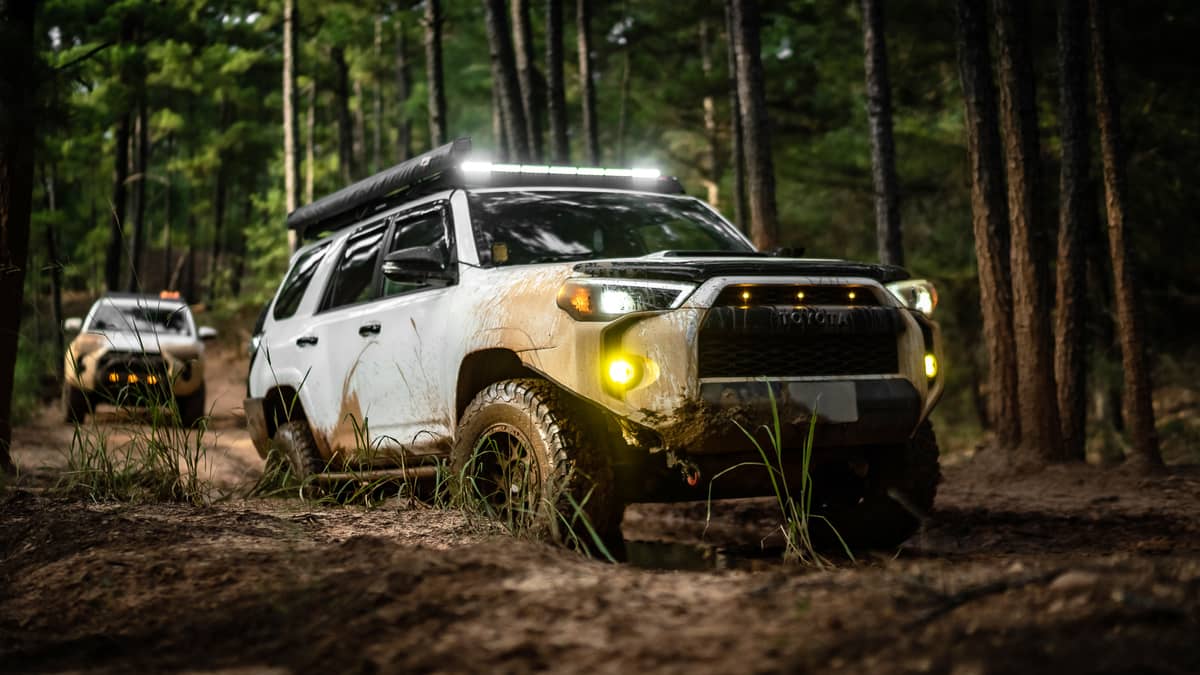
Building a capable off-road vehicle starts with upgrading the right suspension components in the right order. Whether you drive a Jeep, Lexus, Dodge, Toyota, or another vehicle, the same principle holds: not every part of your suspension breaks when you lift your truck — and the ones that do should come first.
Start With What Actually Breaks: Geometry, Not Just Height
When you lift a truck — whichever lift kit style you're running — you're not just adding clearance, you're changing the angles your suspension was engineered around. The upper control arm is almost always the first casualty. It sets caster and camber, the two specs that determine how your wheel tilts and tracks, and a factory upper arm is built around factory ride height. Raise the truck, and that same arm gets forced into an angle it was never designed for — which is exactly why JBA focuses exclusively on upper control arms rather than building a little bit of everything: it's the part that actually needs to change when the geometry changes.
An upgraded upper control arm restores that geometry directly:
- Corrected caster and camber at your new ride height
- Full suspension travel instead of a factory arm binding early
- Clearance for the larger tires most lifts are built around
JBA upper control arms are built for this specifically — a Max 90 ball joint with 90 degrees of articulation (versus roughly 66 degrees on a typical open uniball), and EZ Lube Bushings (U.S. Patent No. 11,293,511) with built-in grease ports so the bushing doesn't need to be pressed out to be serviced. Both are field-rebuildable, not throwaway — a Max 90 Ball Joint replacement runs $72 to $75, versus buying an entirely new arm. The result isn't just a taller truck; it's one that's stronger, smoother, and ready for adventure.
Shocks and Struts: Ride Quality, Not Geometry
Shocks enhance control and comfort by controlling the motion of your springs — how your truck feels cornering, braking, or crossing a washboard trail. Once you lift a vehicle and add bigger, heavier tires, factory shocks (tuned for stock ride height and stock unsprung weight) run out of the damping range they were designed for.
Look for a shock built for your specific lift height and tire size, from a manufacturer that publishes real valving and travel specs for your application — this is a case where "who tuned it for your exact setup" matters more than any single brand name. A shock upgrade won't fix caster or camber the way an upper control arm does, but it's the difference between a lift that rides like a compromise and one that rides like it was built that way.
Coils, Springs, and Load-Handling Support
Coils determine ride height and load capacity. For overlanders, tow rigs, and heavily armored builds, upgraded springs matter for the same reason an upper control arm does — the factory part was sized around factory weight.
If your rear end sags under the weight of camping gear or recovery equipment, that's a coil problem, not a control arm problem: undersized springs also accelerate wear on the joints and bushings above them, since the whole system is now compensating for weight it wasn't built to carry.
Bushings, Ball Joints, and Supporting Hardware
Even the strongest arms and shocks depend on the smallest parts to function smoothly. Rubber bushings soften with heat and mileage; a worn ball joint introduces play before anything else in the system shows a symptom.
This is also where a rebuildable design pays for itself. A worn Max 90 ball joint or EZ Lube Bushing doesn't mean replacing the arm — a rebuild kit and fifteen minutes with a grease gun gets you back to spec. Torque hardware matters here too: the Max 90's 4 mounting bolts to 13 ft-lbs, the ball joint stud nut to 60 ft-lbs, and the frame-mount bushing bolts to 80 ft-lbs. Loose mounting hardware accelerates bushing wear faster than almost anything else.
Upgrade Order Matters
If you're planning a build in stages, this is the order that actually reflects what breaks first when you lift a truck:
- Upper control arms — the geometry fix; nothing else on this list corrects caster and camber.
- Shocks and struts — restores ride quality once your geometry is already correct.
- Coils or springs — sized to your actual load, especially if you're carrying gear or towing.
- Bushings, ball joints, and hardware — the parts that keep everything above them running quiet and precise over the long haul, and the parts worth rebuilding instead of replacing when they wear.
Not sure where to start? Browse real builds to see how other owners sequenced theirs. Or skip the guesswork entirely and get a build list matched to your budget.
Complete JBA upper control arm sets run $603 to $853 depending on your vehicle and lift type, backed by a JBA Lifetime Warranty and 100% Money Back Guarantee. Browse JBA's upper control arm lineup to start with the upgrade that actually fixes your geometry.